Sobre GJF
GJF se rige por la filosofía de cooperación basada en «integridad, innovación, altruismo y beneficio mutuo». Nos dedicamos de todo corazón a servir a nuestros clientes y nuestro objetivo es lograr situaciones de beneficio mutuo en el futuro mercado de recambios de automoción.
Obtener presupuesto gratis
Noticias
24
Jul
Universal Vs OEM CV Joint Boot: Which One Should You Choose? - GJF
Universal vs. OEM CV Joint Boot: Which Should You Choose?
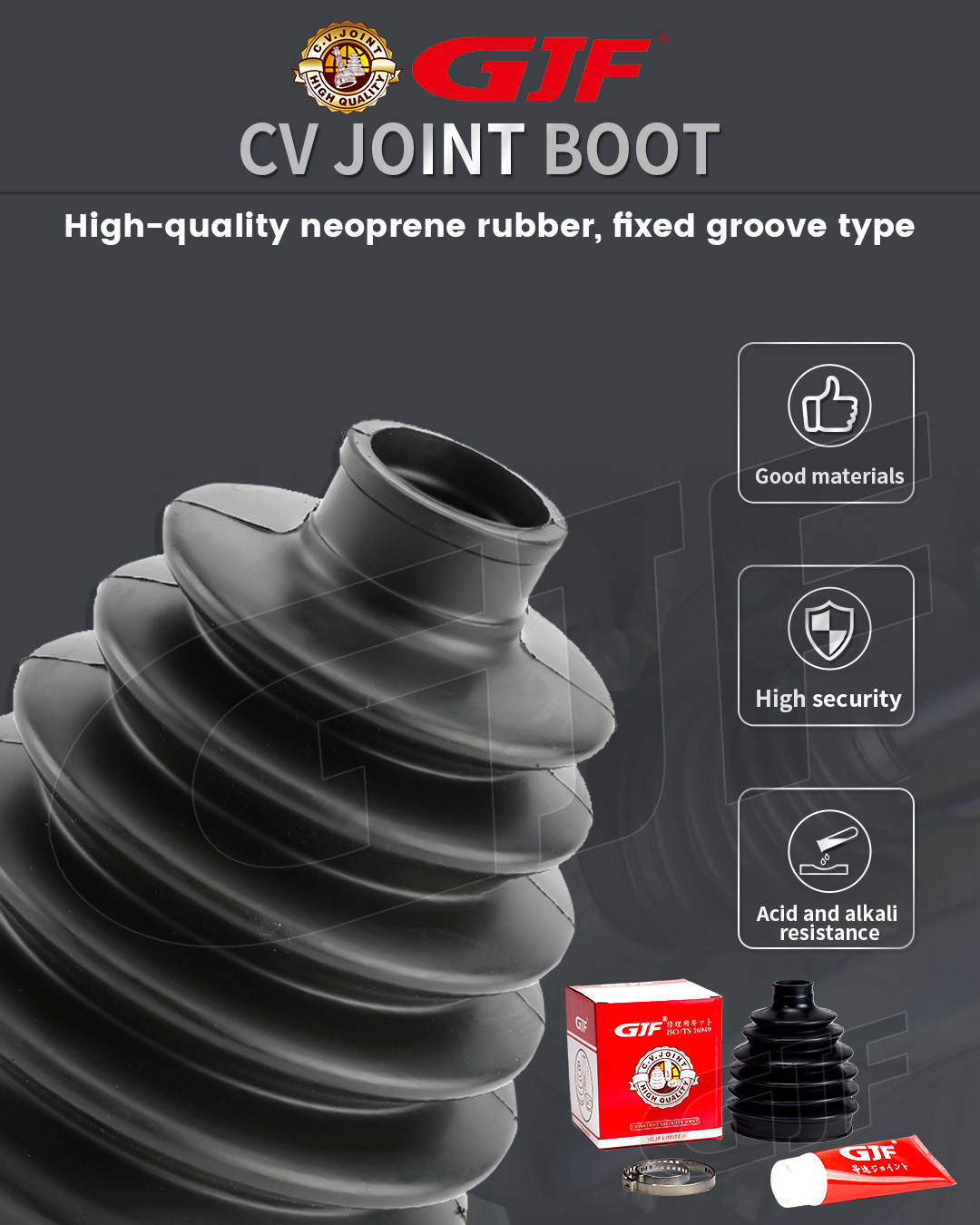
When a CV joint boot becomes cracked, torn, or damaged, replacing it promptly can help protect the CV joint from dirt, water, and grease loss. But which replacement should you choose: a universal CV joint boot or an OEM-style CV joint boot?
Both options can work well when correctly matched to the application. A universal CV boot offers flexibility and broad coverage, while an OEM-style or direct-fit CV boot is designed around the dimensions of a specific application.
In this guide, GJF compares universal vs. OEM CV joint boots, including fitment, installation, durability, cost, and application considerations.
What Is a CV Joint Boot?
A CV joint boot, also called a CV boot or constant velocity joint boot, is a flexible protective cover installed around a CV joint.
Its main functions are to:
- Keep CV joint grease inside the joint
- Prevent dirt and water from entering
- Protect internal components from contamination
- Allow the CV joint to move while maintaining a sealed environment
A damaged CV boot can allow grease to escape and contaminants to enter. If the problem is caught early and the CV joint itself is still in good condition, replacing the boot may prevent more expensive CV joint repairs.
Universal vs. OEM CV Joint Boot
The main difference is how the boot is designed to fit the application.
| Feature | Universal CV Boot | OEM-Style / Direct-Fit CV Boot |
|---|---|---|
| Fitment | Multiple applications | Specific application |
| Dimensions | Adaptable | Application-specific |
| Installation | May require trimming | Usually direct fit |
| Vehicle coverage | Broad | Model-specific |
| Inventory | Fewer SKUs needed | More SKUs required |
| Flexibility | High | Designed for specific movement |
| Best for | Flexible repairs | Precise replacement |
Neither option is automatically better. The correct choice depends on the vehicle, CV joint design, dimensions, and repair requirements.
Universal CV Joint Boot
A universal CV joint boot is designed to fit a range of applications. Many universal boots use stepped diameters that can be trimmed to match different shaft and CV joint dimensions.
Advantages
Broad application coverage
One universal CV boot can potentially serve multiple vehicle applications.
Simplified inventory
Repair shops and distributors may need fewer part numbers to cover a wider range of applications.
Flexible replacement option
A universal boot can be useful when the exact application-specific boot is unavailable.
Disadvantages
More installation work
The boot may need to be measured and trimmed before installation.
Fitment requires attention
The small-end diameter, large-end diameter, and boot length must all be suitable for the application.
Incorrect modification can affect sealing
If a universal boot is cut incorrectly or does not match the joint properly, it may leak grease or allow contaminants to enter.
A universal CV boot is therefore a practical option when flexibility and broad coverage are more important than direct-fit convenience.
OEM CV Joint Boot
An OEM CV joint boot, also described as an OE replacement or direct-fit CV boot, is designed to closely match the original boot for a specific application.
For aftermarket products, "OEM-style" or "direct-fit" is generally a more accurate description than simply calling the product "OEM."
Advantages:
Precise fitment
The boot is designed around the dimensions and requirements of a particular application.
Easier installation
A properly matched direct-fit boot usually requires little or no modification.
Reliable sealing
Correct mounting dimensions help maintain a secure seal around the shaft and CV joint housing.
Proper joint movement
A correctly designed boot allows the CV joint to articulate and, where applicable, accommodate plunge movement without excessive stretching.
Disadvantages:
More part numbers
Different vehicle applications require different CV boot designs and SKUs.
Higher inventory requirements
Distributors may need to stock more application-specific products.
For professional workshops and application-focused aftermarket sales, an OEM-style or direct-fit CV boot can provide a more convenient replacement solution.
Which CV Joint Boot Should You Choose?
The answer depends on your priorities.
Choose a Universal CV Boot If:
- You need broad application coverage
- The correct dimensions can be accurately matched
- A flexible inventory solution is important
- Some installation adjustment is acceptable
- The application does not require a specific molded boot design
Choose an OEM CV Boot If:
- You want application-specific fitment
- Easy installation is important
- You want to minimize modification
- The original boot has a specific shape or mounting design
- Consistent fitment is important for professional repairs
For most professional replacement applications, correct fitment is more important than whether the boot is labeled universal or OEM.
The replacement boot should match the CV joint's dimensions, movement range, operating environment, and sealing requirements.
How to Choose the Right CV Joint Boot
Before purchasing a CV boot, check the following specifications:
1. Small-End Diameter
The small end must securely fit the drive shaft.
2. Large-End Diameter
The large end needs to match the CV joint housing.
3. Boot Length
The boot must provide enough length for the joint's normal movement without excessive stretching or compression.
4. Material
The material should provide suitable flexibility, wear resistance, temperature resistance, and resistance to CV joint grease.
5. Joint Type
Confirm whether the boot is intended for an:
- Outer CV joint
- Inner CV joint
- Ball-type CV joint
- Tripod-type CV joint
Inner CV joints can have different designs, so the boot must match the specific joint structure.
6. Vehicle Application
Whenever possible, use the vehicle make, model, year, engine, OE/reference number, and joint specifications to confirm fitment.
When Should You Replace a CV Joint Boot?
Inspect the CV boot if you notice:
- Cracks or tears
- Grease around the boot
- Loose or damaged clamps
- Hardened rubber
- Excessive deformation
- Visible contamination
If the boot is damaged but the CV joint remains clean and undamaged, CV joint boot replacement may be sufficient.
If the joint already has excessive play, abnormal noise, vibration, pitting, or other internal damage, replacing the complete CV joint may be the better solution.
GJF CV Joint Boot Solutions
GJF supplies CV joint boots for a wide range of automotive applications, supporting distributors, wholesalers, importers, and automotive parts businesses.
GJF's drivetrain product range includes:
- CV Joint Boots
- Inner CV Joints
- Outer CV Joints
- CV Joint Kits
- Drive Shafts
- Intermediate Shafts
- Wheel Hub Bearings
With a focus on precise fitment, durable materials, and consistent manufacturing quality, GJF provides aftermarket drivetrain solutions for different vehicle applications.
Whether you need an OEM-style CV joint boot for a specific application or flexible solutions for aftermarket distribution, GJF can help with product matching and sourcing.
Looking for a reliable CV joint boot supplier? Contact GJF for application matching and wholesale solutions.
Frequently Asked Questions
Are universal CV boots any good?
Yes. A universal CV boot can be a reliable replacement when its dimensions, material, flexibility, and operating range are suitable for the application and it is installed correctly.
Is an OEM CV boot better than a universal CV boot?
An OEM-style or direct-fit CV boot generally provides more precise application fitment and easier installation. A universal CV boot offers broader coverage and greater flexibility. The better choice depends on the specific application.
Can I replace an OEM CV boot with an aftermarket CV boot?
Yes. A quality aftermarket CV boot can replace the original boot when it meets the required dimensions, material specifications, and application requirements.
How do I know what size CV boot I need?
Check the small-end diameter, large-end diameter, overall length, and joint type. Vehicle application information and OE/reference numbers can also help confirm the correct replacement.
Can a universal CV boot be used on an inner CV joint?
Yes, provided the universal boot is suitable for the specific inner CV joint design and its dimensions and movement range are correct. Both ball-type and tripod-type inner CV joints require appropriate boot designs.
Final Thoughts
Choosing between a universal CV joint boot and an OEM-style CV joint boot comes down to fitment, installation requirements, application coverage, and operating conditions.
Universal CV boots provide flexibility and broad coverage, while OEM-style or direct-fit CV boots offer more precise application matching and generally easier installation.
Regardless of which type you choose, the most important factors are correct dimensions, suitable material, reliable sealing, and proper installation.
For distributors, wholesalers, and automotive parts businesses looking for CV joint boots, inner CV joints, CV joint kits, and complete drive shaft solutions, GJF provides a broad range of aftermarket drivetrain products.
Need the right CV joint boot for a specific vehicle application? Contact GJF to check product availability and fitment.
Etiquetas :
Publicaciones recientes